Choose the source
Use a notebook page, worksheet, textbook extract, whiteboard photo or PDF that reflects the lesson.
ASSIGNMENT WORKFLOW FOR TUTORS
A practical workflow for turning the material you already taught into focused student practice, while keeping the tutor in charge of the final assignment.
The short answer
Take a readable photo of the notebook page or worksheet, check that the important examples and instructions are visible, choose a short practice set, and review each question before you share it. The best assignment is usually a focused follow-up to one lesson, not a copy of everything covered in a term.
For a longer workflow, Rankerd’s assignment creator for tutors supports notebook photos, images, PDFs and pasted notes, with tutor review before publishing.
A SIMPLE FOUR-STEP PROCESS
Use a notebook page, worksheet, textbook extract, whiteboard photo or PDF that reflects the lesson.
Decide whether the learner needs recall, worked examples, application or a quick check before the next lesson.
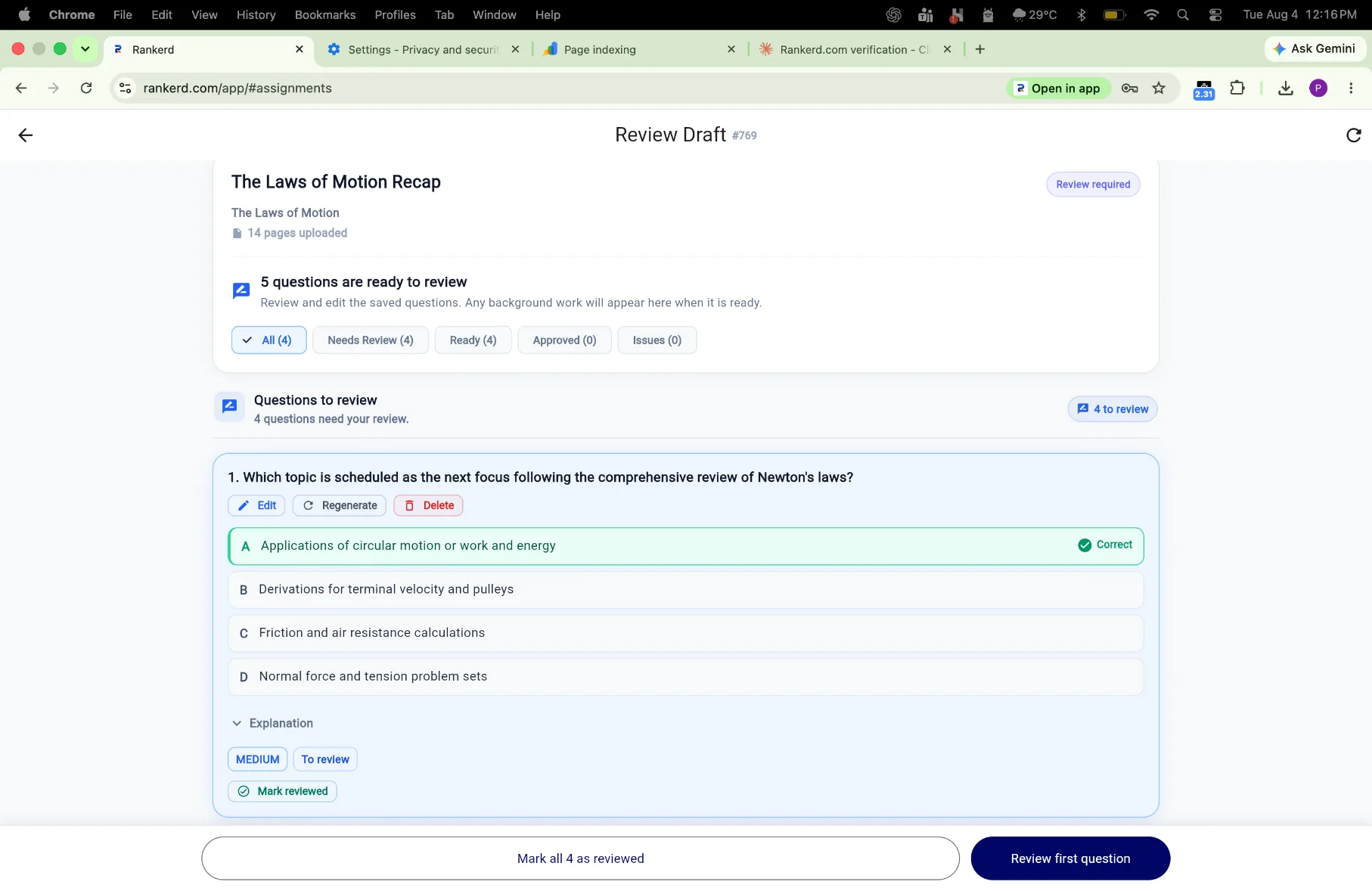
Check wording, answers, level and coverage. Edit anything that does not fit the learner or the lesson.
Send the assignment to the student, then use the result to decide what to revisit next.
BEFORE YOU TAKE THE PHOTO
What to review before sharing
Read every question as if you were the student. Check that the expected answer follows from the source material, that the wording is unambiguous and that the difficulty is appropriate. A short assignment with a clear purpose is more useful than a long list of loosely related questions.
After the attempt
Look for repeated errors, unfinished work and questions that took unusual effort. Record the teaching decision that follows: reteach the method, provide another example, or move to a new application. This keeps assignment work connected to the next lesson instead of treating a score as the whole story.
For the wider workflow, keep student progress in context and prepare a clearer parent update when it is useful.
Review a focused practice set before sharing it with your student.
See the tutor assignment workflow